
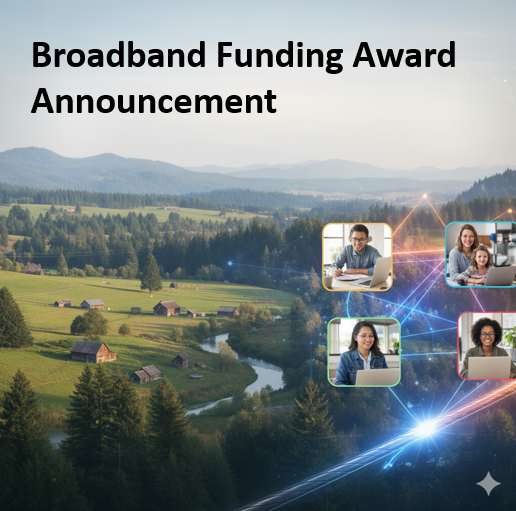
Columbia County, Oregon, has been recommended for $9.5 million in funding through the Broadband Equity, Access, and Deployment (BEAD) Program, which is particularly significant because Columbia County is one of only four public entities in Oregon to receive such an award. For a county that has long faced challenges in making high-speed broadband available to all businesses and residents, this represents an important step toward closing longstanding service gaps
Preparing for County Broadband Opportunity
Broadband infrastructure gaps have an increasing economic cost. Recognizing the importance of reliable broadband for economic development, education, and healthcare, Columbia County took steps to position itself to improve service availability and pursue federal broadband funding opportunities.
Columbia County started the process by identifying underserved areas and developing a regional broadband plan. Next, Columbia County engaged Strategic Networks Group to support this work, by helping the County make the economic case for broadband and conducting a comprehensive Broadband Economic Feasibility Assessment. This detailed assessment demonstrated how a County-owned fiber network could be financed through a combination of residential subscriptions and community anchor institutions (CAIs) connectivity. It also provided crucial evidence that the network could achieve financial sustainability by serving both high-cost rural and commercially viable areas, which is a key component in making the business case for public investment.
Columbia County also facilitated critical partnerships with local Public Utility Districts, putting together infrastructure agreements that provided in-kind asset valuation to offset cash contributions needed for BEAD’s 25% matching requirement. Beyond the matching funds, those partnerships enhanced the overall broadband project by demonstrating how utilities could benefit from fiber access for their own operations while supporting expanded connectivity throughout the region. Other project stakeholders included local business organizations, port authority officials, and municipal jurisdictions within the county who participated in a coalition of local partners that support the project and advocate for long-term viability.
In preparation for BEAD, the County established a contracting framework that brought in a qualified operating entity. Through a competitive process, an open access network operator was selected. This partnership was central to the County’s BEAD application, focusing on network sustainability and operational capacity to ensure the project aligned with BEAD funding goals. The network operator, in turn, benefited from the established County-wide support for the broadband initiative.
Navigating Program Changes and Award Summary
The journey to receiving the BEAD award recognition has not been straightforward. Midway through the BEAD application process, new federal guidance required states to adjust their programs to incorporate what became known as the “Benefit of the Bargain” round. This new phase required states to select the lowest-cost applicants for BEAD-eligible locations, regardless of technology. By adapting quickly and working closely together, the County and network operator were able to keep their application strong and secure awards for the County.
The state of Oregon awarded a total of $620,732,751 to broadband projects through the BEAD program, with only $15,032,943 of awards to public entities (less than 3%). Columbia County received nearly two-thirds of those public entity BEAD award monies across three school districts. The award for Columbia County includes over $9.5 million in broadband funding to bring service to more than 2019 unserved and underserved locations across the Rainier, Scappoose, and Vernonia District Grant areas. These investments will directly benefit households, small businesses, and community anchor institutions that currently lack adequate access to reliable, high-speed internet.
The awards are pending review and final approval by the NTIA, with a decision expected for the beginning of December 2025.
Looking Beyond BEAD
While the BEAD awards are an important milestone, they are not the end goal. Columbia County has faced persistent broadband challenges, with large portions of the county still lacking reliable service. Building on the BEAD-funded projects, the network operator is looking to use this as an opportunity to expand its network and extend service more broadly across Columbia County. By doing so, the County aims to create a sustainable broadband infrastructure that can meet community needs for decades to come.
“What began with a recognition that county residents lacked sufficient broadband access, has grown into a multi-year project to provide a solution, that recently reached a major milestone – our preliminary BEAD award. This effort has required a great deal of problem-solving, multi-agency collaboration, and resilience, but I’m incredibly proud of what we’ve accomplished so far. Reliable broadband unlocks opportunities—remote work, home-based businesses, telehealth, education, and economic growth. I’m committed to bringing these opportunities to every part of our community and thankful for the partnership with SNG, a steady and crucial source of support throughout this journey.”
Holly Miller, Columbia County IT Director
Building a Stronger Future
This award recognition highlights the progress Columbia County is making toward improving broadband access. Reliable internet is increasingly essential for tele-workers, students, businesses, and residents alike. By moving these projects forward, the County is laying the groundwork for stronger communities, new opportunities, and improved quality of life for its residents.
Strategic Networks Group is proud to support Columbia County in reaching this milestone. We look forward to continuing our work as these projects take shape and building towards a more connected future.
Contact SNG to learn more about SNG’s projects and how we help communities achieve their broadband goals.
Camp Sherman, Oregon: A Community in Need of Broadband
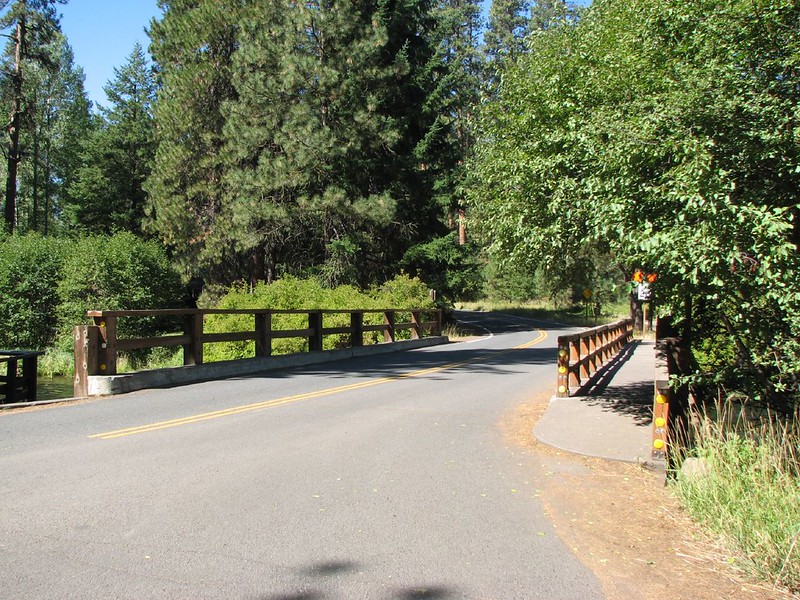
Photo: Camp Sherman Bridge across the Metolius River by DBerry
While it may not face the same economic barriers as many other rural areas underserved with broadband – with household incomes approximately 20% higher than the Oregon average – Camp Sherman, Oregon, has broadband gaps and is now stuck in broadband limbo.
Camp Sherman is a small, unincorporated community nestled in the Deschutes National Forest of Central Oregon. The community has clear goals to improve connectivity. Local leaders and residents formed a broadband task force, engaged stakeholders, and launched CampShermanFiber.com to share updates and rally community interest. While these important steps have shown the community has demand and a pressing need for broadband, there has been difficulty in achieving results.
Even though the area was selected as a Federal broadband RDOF grant award recipient in 2020, the project never came to fruition. Like many other communities facing similar hurdles, the program that provided a brief period of hope for residents to get broadband service, ended up as a default on commitments, leaving the goal of achieving high-speed internet back to square one.
Today, Camp Sherman remains unserved by fiber. Residents rely on satellite or fixed wireless connections which have proven inadequate for work-from-home professionals, students, and local small businesses. Additionally, Camp Sherman is under the canopy of conifers, obscuring the sky view of satellites and many residences and businesses simply cannot connect to satellite providers, leaving them with no option at all to connect to the internet.
Camp Sherman also highlights the unique challenges of rural broadband planning:
- Seasonal residency patterns can complicate demand forecasting and network return on investment.
- Low housing density and forested terrain make construction costly.
- Despite higher incomes, the community lacks the scale to attract traditional private investment on its own.
Camp Sherman shows that even relatively affluent communities, the so-called “haves”, can still lack broadband access and thus ‘have-not’.
When it comes to building digital infrastructure, there is no substitute for working closely with a community to address its specific needs. There is no a one-size-fits-all solution to providing internet service in places that struggle to attract traditional market driven investment.
An individualized case must be developed to show that utilization of broadband from a community’s residents and businesses can support an investment in digital infrastructure. Building an economic case for investing in broadband needs to breakdown traditional silos and bring together many factors including the need to support online services such as telehealth, online education, and public safety communications. In addition, the support of community leaders is paramount to supporting the long-term vision and the benefits that internet connectivity can enable for a community. There are also other considerations such as, an area’s relative vicinity to other regional municipalities, which can increase the scale of broadband planning and develop the market viability to support digital infrastructure investment.
“Black Butte School District has been leading the charge in Camp Sherman towards fiber, for over 10 years. We have experienced one devastating set back after another, leaving us now in a state of limbo. We are wondering if anyone will believe us when we say that satellite and fixed wireless internet do not work under the canopy of pines. Fiber is our only option for our community to enter into the 21st Century. Without it we will simply be limping along patching together solutions that do not actually fix the problem. We live at least an hour away from most doctors, and would love to choose to video conference with them, but with satellite providers, these calls drop, skip, or become garbled. Many people choose not to invest in our community because of our lack of internet, so the long-term sustainability of our community is in the balance.” Jennie Sharp, Special Projects Manager, Black Butte School District
What Can Communities Do Now?
With delays and uncertainty in government broadband funding (e.g. BEAD and RDOF) , communities need a new strategy—one that’s locally driven, financially sustainable, and less dependent on government subsidies.
Plan for Action, Not Just on Paper
Communities need to go beyond high-level strategies and feasibility studies that are not actionable. They need to produce investment-ready, technically and financially viable broadband plans that align with market opportunities. Broadband planning and technical feasibility assessments need to aggregate demand and build a sustainable business case that will attract internet service providers (ISPs) and infrastructure investors.
Bring Funding Options to the Table
Consider options such as revenue bond financing and public–private joint ventures, which are powerful tools that exist for communities to leverage municipal and stable market conditions in order to help clients structure broadband projects that do not rely solely on slow-moving federal programs. Communities that are ready to take steps to address broadband should determine the best approach that suits their current status and aims (see Options to Bridge Broadband Gaps).
Engage Local Partners who are Stakeholders
Some of the most valuable partners in the broadband space, are local organizations that are already or could/should be using the internet as a part of their everyday operations. These can include local education and health institutions, as well as non-profit and government organizations that are directly engaged with the local community. Understanding the needs of these organizations can help shape the best approach to solving broadband challenges and improving utilization.
Use Data to Build Support and Reduce Risk
By conducting granular market assessments and financial modeling tools help communities delineate and define underserved areas, quantify demand, and evaluate the economic impacts of broadband investments, communities can provide validation for return on investment that is critical for securing stakeholder buy-in and minimizing risk for investors.
The Bottom Line
We’re in a moment where the broadband future feels uncertain. But that does not mean communities should wait. It means they should act.
Taking action on your broadband future includes:
- Developing an economic case for broadband by showing how high-speed internet access drives jobs, education, healthcare, and community growth to help secure funding and investment
- Building consensus to help elected officials and key stakeholders make informed decisions on why broadband is critical
- Identifying opportunities for budgets to use existing allocations to self-finance digital infrastructure
- Conducting broadband market demand analysis and financial modeling for funding and private investment (including bond and grant opportunities)
- Hiring an owner’s representative so networks are designed, built, and operated to address community needs – and drive network uptake and utilization of online practices for network sustainability, local economic impacts, and community benefits
Contact SNG for more information about how we help communities overcome these challenges, avoid common pitfalls, and deliver results in broadband planning and deployment. Let’s build broadband infrastructure that gets funded, built, and drives community benefits by starting with two questions:
- Are your community leaders ready to move forward on a broadband initiative? Use the Digital Needs and Readiness Assessment to find out
- To what extent could existing telecommunications budgets finance your digital infrastructure? Take the Broadband Economic Feasibility Assessment
How Jefferson County, Oregon Secured $19M for Broadband — With a Plan Built on Local Insight and Hard Data
In rural communities like Jefferson County, Oregon, broadband isn’t just about speed — it’s about access to opportunity. Whether it’s farming operations relying on remote sensors, local students trying to do homework and access remote learning, or small businesses needing to reach customers online, reliable internet is essential infrastructure.
That’s why in 2021, Jefferson County partnered with Strategic Networks Group (SNG) to take a hard look at their broadband challenges — and opportunities. The result? A detailed, data-driven plan that helped the County successfully secure $19 million in broadband funding from the state’s Broadband Deployment Program.
Understanding Local Needs
SNG started by working closely with County officials, local stakeholders, and tribal representatives to understand the full picture. Broadband gaps in Jefferson County weren’t just about geography — they were tied to how people lived, worked, and accessed services across the region.
Through interviews, planning sessions, and our Digital Needs & Readiness Assessment, we helped surface the community’s broadband priorities:
- Stimulating local business growth and expanding local workforce skills
- Remote learning and online education support for students
- Connectivity for agricultural businesses and water management
- Faster emergency response across a large rural service area
This kind of listening and understanding local needs was essential — it laid the groundwork for a plan that reflected the realities on the ground and incorporated direct input from local leaders who emphasized the need for equitable access, resilient infrastructure, and long-overdue investment in rural connectivity.
Filling in the Data Gaps
SNG then got to work collecting the data needed to make the case for investment, including:
- Deploying eCheckup assessments to local businesses and residents to assess current internet utilization, satisfaction levels, and conduct verified internet speed tests
- Mapping unserved and underserved areas, as well as critical infrastructure locations
- Estimating demand and identifying areas where private providers had little incentive to expand
One of the most striking findings? Nearly 80% of residents said they’d switch providers if better service were available — clear evidence of unmet demand.
Turning Insight into Strategy
With strong local input and a solid dataset in hand, SNG worked with County leaders to develop a broadband strategy. This wasn’t a generic plan — it was tailored to Jefferson County’s geography, economic goals, and technical realities.
The strategy included:
- Cost estimates for building middle-mile and last-mile infrastructure
- Partnership models for working with ISPs and utilities
- Governance options for overseeing the network long-term
- Action steps to improve online adoption and utilization programs
The goal was to equip the County with a clear, actionable roadmap to guide decisions, attract investment, and take meaningful steps toward a more connected and resilient broadband future.
A Plan that Delivered Results
Following Jefferson County Commissioners’ official adoption of the Broadband Assessment and Strategic Plan, the County had a clear picture of the approach and infrastructure improvements required to achieve results.
Working with SNG to develop a funding application grounded in local priorities and backed by strong data, the County successfully secured nearly $19 million through Oregon’s Broadband Deployment Program. This funding will support the expansion of fiber broadband to over 1,800 unserved and underserved locations, in partnership with a local private internet service provider.
It’s a big win — and one that didn’t happen by accident. It happened because the County had a clear, data-backed plan and could show how investment would translate into real benefits for residents, businesses, and institutions.
What This Means Going Forward
Now, Jefferson County is moving into the build-out phase. But the work doesn’t stop with construction. The County is continuing to draw on the guidance provided in SNG’s strategic plan as it explores ways to support adoption and ensure the network reaches those who need it most — including through digital navigator programs and ongoing coordination with tribal and regional partners.
For more information about this project, visit SNG’s webpage for Jefferson County
More information about the Broadband Deployment Program Oregon Awards