In June, we announced SNG’s popular new offering: the Digital Economy index scorecards. A composite score of how businesses and organizations use seventeen (17) online practices, or “e-solutions,” the Digital Economy index (DEi) is a unique assessment tool that can be used at any industry, sectoral, or geographic analysis of businesses and organizations to drive productivity and competitiveness.
 DEI enables businesses and organizations to see where they stand relative to their peers. SNG personalizes the value of online practices to individual businesses and organizations by producing customized scorecards that show where improvements can be made to be more productive and competitive an increasingly online economy.
As SNG’s DEi is a composite score of how organizations use online practices to drive productivity and competitiveness, DEi can also be shown strengths and weaknesses within industry sectors.
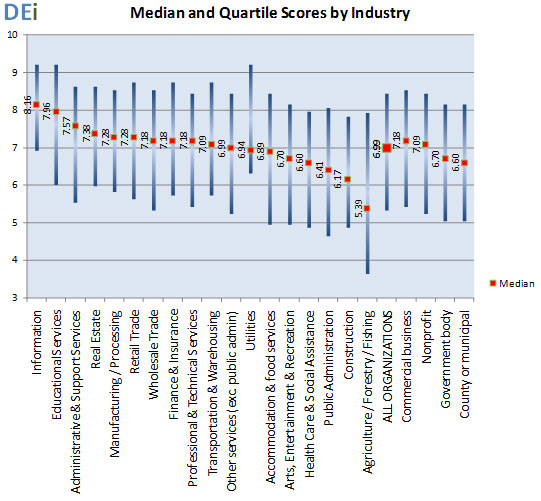
As we’ve just completed our latest work in North Carolina, let’s take a look at the DEi results by industry and sectors for North Carolina. The overall median DEi for all organizations surveyed in North Carolina is 6.99, with 50 percent of organizations falling between a DEi of 5.34 and 8.45. These scores compare utilization of e-solutions between industry sectors and we’ll explore what that means below.
Opportunities for increasing DEi scores, with the accompanying economic benefits, can be identified and prioritized for action by businesses and organizations.
For example, in North Carolina, the Construction industry (DEi = 6.17) and Information Services industry (DEi = 8.16) have among the lowest and highest median use of 17 types of Internet applications or processes. The average DEi for North Carolina was 6.99 (high is better).
Some of the differences in the DEi score reflect unique characteristics of the structure of that industry. For example, the Construction industry has very high use of certain applications, such as supply chain management and document transfer, while having low use of tele-working.
One interesting example of using the DEi is a comparison of the Education industry (high DEi of 7.96) and Health and Human Services industry (low DEi of 6.60). Comparing these two industries highlights the extent to which the Education industry has pioneered such Internet uses as direct service delivery and remote counselling, while Health and Human Services lag significantly in these areas.
SNG’s proprietary DEi benchmarking capability is a critical tool for proponents of broadband and economic development because DEi shows where organizations and industries are leveraging broadband – and where they should be adopting online practices that will keep them competitive and relevant in a digital economy.

Unanswered Questions, Unfulfilled Leadership
I was reading the other day about how firms in my homeland of Canada are filling the gaps left by the government’s decision to axe the long-form census. In this case, the newspaper (okay, not a real newspaper – the online version) described a firm that is collecting data about the workforce so that organizations can better understand how to attract and retain employees. This is a private sector firm collecting data to uncover what used to be provided by government agency Statistics Canada.
 What is this story really about? Is it about the private sector is naturally filling a void created by a government cutting programs? Or is this a story about how leaders need insights… decisions need background information, and strategies need guidance? Just because it is a cliché does not mean it is not true… Knowledge is Power. The best decisions are made with better information. The best strategies are based on market intelligence. And investments are best leveraged when you know where they can have the most impact.
Governments poised to compete in the 21st century global economy realize that to thrive, they need to be able to leverage the resources they have, make the right decisions, and provide their businesses with an ability to innovate and capture markets. Good planning requires insights into opportunities within the context of available resources and tools to overcome barriers.
Regions with governments that are cutting back on information gathering will not have the data and insights they need to create winning strategies and develop programs that foster growth. Without naming names, we all know of regions that are depressed and struggling more than others. What do most have in common? Weak or nonexistent strategies. And behind that, a lack of insights needed to succeed. So who will fill the void?
I founded SNG 12 years ago to help communities and regions make better decisions about their broadband investments and show them how to better leverage the networks for economic and social development. This requires assessing needs, benchmarking gaps, and helping regions plan strategically to shorten the path to desired outcomes and impacts. In essence, SNG is translating broadband into opportunities and jobs through fact-based economic strategies.
If you don’t measure, you can’t manage … and you surely cannot develop successful strategies that will give the stakeholders in your communities and regions what they need to compete and lead in today’s knowledge economy. Without intelligence and insights on where you are now as compared to where you want to be, you are forced to be a follower. In the globally competitive marketplace, it’s the innovators that will benefit from a high wage economy and with it, high quality of life.
SNG maximizes limited resources by identifying key economic levers on which to pull and we do this on a case by case basis. SNG can help get you the information you need for your own creative strategies from a region-wide standpoint. In addition, our DEi Scorecard can give you insights all the way down to the individual organization level. For example, businesses can receive individual reports to let your entrepreneurs know how they stack up against local and global competition and what they need to do to be more competitive.
SNG: The Broadband Economists
If you’ve been to out website in the past few weeks, you’ve seen some drastic changes.

Let’s start with our new tagline, “The Broadband Economists.” What, you may ask, does this mean? At its heart, SNG is a group of broadband economists who develop strategies for most effectively leveraging broadband investments. But what exactly is a “broadband economist?” Well it is not a bean counter or an abstract thinker who cannot apply theory into practice. We are economists in the sense that we are looking to help make the most broad-reaching and transformational impacts that broadband can bring enable businesses, communities and regions. Our goals: economic development, social advancement, increased productivity and competiveness.
Our website, www.sngroup.com, also has a new look and is much easier to navigate. Enhancements include new insights for broadband initiatives in blogs, articles, newsletter archives, etc. We’ve provided tips and success stories to help successfully navigate and manage successful broadband initiatives through the Broadband Lifecycle
We’ve taken great pains to help everyone, from elected officials to business professionals to technology experts, better understand the keys to successful, transformative, and economically impactful initiatives. Visit our site on a regular basis for updates and broadband news as we’ll be monitoring the broadband industry – and its best practices – to help to ensure your success.
A Fresh Look at the Digital Divide
by Derek Murphy
 A lot of funding is being invested in broadband infrastructure, which will bring high speed connectivity to many communities and regions around the world who previously did not have high speed access. As the number of communities without access to broadband declines, there will be room, both politically and financially, for other priorities. Within the context of the digital divide, what priorities need to be articulated and placed on the political and policy map?
For example, as planning and mapping efforts unfold across the United States, including our own SNG projects in North Carolina, Virginia, Louisiana, and Kentucky, more and more evidence is emerging of a shifting picture that is more complex than just “un-served” “under-served” and “served” as defined in the United States by the National Telecommunications and Information Administration. These relatively broad categories have played their role, but need to evolve if they are going to be useful for future planning efforts based on evidence that we have recently collected.
“39% of households would very likely relocate to another community if broadband was not available. Over 55% of organizations say that broadband is essential for remaining in their current location.” Recent SNG Technical Report for a designated State broadband authority.
Unserved communities: Recent SNG research shows that the vast majority of businesses and organizations (97 percent) have Internet connectivity. As a consequence, unserved communities are now primarily composed of residential areas, rather than whole communities that include business districts. In addition to the impacts on individual households, there are two significant dimensions to the digital divide faced by unserved communities. First, the higher the percentage of areas having broadband connectivity, the greater is the disadvantage experienced by the remaining unserved communities. e-Solutions Benchmarking data show a pronounced tendency of businesses and households to make decisions on where to locate based on the availability of high speed and reliable broadband. Second, a large percentage of economically active households use their home to generate income, either through teleworking or home based businesses. With economically active households making locational decisions with connectivity in mind, rural areas without broadband will lose economically active households, with major negative impacts on their long term sustainability.
Unserved pockets within served communities: SNG research has shown that these areas are primarily low density residential areas, usually rural and/or low income. Mapping efforts have been useful in identifying unserved communities but may be less effective at identifying the pervasive but smaller unserved areas within “served” communities. These low density areas provide a poor business case for infrastructure investments by current Internet Service Providers. Small areas are less likely to be the focus of infrastructure funding programs. As current efforts have their desired impact of reducing the number of unserved communities, it can be anticipated that a larger portion of unserved households will fall within this category of “unserved pockets within served communities.” Any strategy to address this aspect of the digital divide will necessarily be different from strategies used for unserved communities. The small scale and scattered nature of the target of population, together with the lack of institutional capacity, will require more imaginative approaches, either with incumbent ISPs or with small but agile wireless ISPs.
Uncompetitive Broadband: There already is significant recognition that much of the existing broadband infrastructure in North America consists of relatively low speed technologies. Fifty percent of the business respondents to a recent statewide SNG survey had upload speeds of less than 700kbps. Additionally, a significant portion of respondents indicated that they were unsatisfied with the speed and/or reliability of their broadband connection. This level of dissatisfaction can be expected to increase as reliance on Internet increases and the gaps between levels of service increases between highly served and poorly served areas.
While much of the current debate on “better broadband” focuses on improving speeds, the reliability issue should be considered as an equal or higher priority. Recent SNG surveys show that reliability and availability of redundancy are increasingly important to many businesses and organizations who state that the Internet is essential to their operations. For these organizations, availability of reliable service and redundancy will play an increasingly large role in their location decisions.
Over the few years, analysts and policy makers have used various terms to describe the need for “better broadband.” However, there remains the danger of using a simple threshold to determine whether a community or region has the desired level of Internet connectivity. A fundamentally stronger concept is that of “competitive broadband.” Competitive broadband recognizes that upgrades to infrastructure are required well into the future to maintain competitiveness globally and regionally. Without competitive infrastructure, businesses and people will quickly or slowly move to greener pastures.
Need for Mobile Broadband: while not the focus of this article, there needs to be acknowledgement of the growing role that mobile broadband plays. In SNG research, organizations and businesses state that mobile Internet is essential to their operations. The use of mobile devices and applications for “untethered access” is expected to continue to grow and become increasingly integrated into how organizations use the Internet. In planning and designing future broadband initiatives, care needs to be taken that the lack of mobile broadband doesn’t become the latest symptom of a digital divide.
As communities and regions absorb the impacts of recently announced broadband investments in infrastructure, planning and adoption, it will be important that we not remain stuck in the terminology and concepts that guided these investment programs. The very success of these investments will require us to evolve our analysis and planning.
As always, thank you for your continued support. If you have any questions or feedback, please don’t hesitate to get in touch!
“The broadband lifecycle: e-strategy, pre-planning, and building capacity”
This month we continue our three-part series covering the steps of the broadband lifecycle as we focus on the strategy and the decision to invest, as well as the network build, or expansion.
By Michael Curri – Broadband networks can create a “platform for productivity, competitiveness and innovation” in your community – delivering the infrastructure to capture economic and social opportunities, some known, some yet to be invented. Many communities fail during the broadband strategy, build-out and adoption phases as they lack focus and/or sufficient investment of time, energy, and resources.
Too often communities develop strategies based on following recipes from other regions. Instead of uncovering what the needed resources are, or how to leverage current efforts to best serve the specific and unique needs of the community, civic leaders race to “do what they did.”
There is no ‘one size fits all’ solution for successful broadband strategies that bring economic and civic benefits to a region and its citizens. Each community not only has different needs, but different strengths to best leverage the broadband platform. Strategic Networks Group (SNG) has for years been helping governments, at municipal, regional and national levels, to best understand where investment will make the biggest impact – and each and every time the best approach involves following the broadband lifecycle.
Before your community can thrive with its own “platform,” you need to get over the common pitfalls along the broadband lifecycle. In case you missed it, last month we reviewed how initiatives can fall flat because of a lack of focus and/or sufficient investment of time, energy, and resources (demand analysis and pre-planning). SNG encourages all broadband project managers to design and run their broadband initiative with one eye on the Broadband Lifecycle. Click here to review steps one and two.
Step 3: e-Strategy & decision to invest
Often the toughest stage – this is where you and your partners in this journey need to ask yourself some tough questions, including – should we proceed? Obviously, you’ve started the journey, so you believe in the value and benefits that broadband can provide your community. But while you (and your colleagues) may be ready to proceed with building your region’s very own “platform for innovation” – will it be used, will it be sustainable? In short, have you addressed the key factors in the pathway to sustainable success?
Obviously, you’re not asking the “are we ready” question in a vacuum. A critical component of being “ready” is understanding the investment required – where the it will come from – and what the measurable benefits will be… will they outweigh the costs?
One way to do this is through SNG’s Community Broadband Readiness Self-Assessment, a process that SNG is taking communities through across the United States – most recently in Miami. The assessment tool provides a comprehensive understanding of the relative value of key factors that should be addressed as a pathway to sustainable success.
 The Community Broadband Readiness Self-Assessment Tool is structured around six readiness categories:
- Leadership
- Vision and Plan
- Organizational Stability
- Community Awareness
- Implementation Ability
- Market Profile
For example, the readiness assessment showed that Miami-Dade had a relatively high level of readiness to undertake a broadband initiative.
SNG can help guide you in this phase applying market analytics and our proprietary Community Broadband Readiness Self-Assessment Tool. By shaping your strategy to address not only broadband for un/under-served areas, but to include applications to drive innovation and efficiencies, we’re able to help establish a strategy to maximize broadband’s benefits. Recently SNG conducted readiness assessments for Miami Dade (FL), Lexington (KY), Akron (OH), Aberdeen (SD), providing an objective view of the current state of readiness for undertaking a broadband initiative
Step 4 – Build or expand network capacity
This step seems like the most straightforward – but don’t be fooled. While we know that building the network is can be the most difficult step, we all have or are a part of a technical team that specializes in building networks. But there are many implications – that without the right guidance and discipline – could be neglected.
Are your technical and business plans in place to ensure a smooth implementation? Do you have the right provider – and are your requirements well defined? SNG has helped regions in Ontario and partnered with organizations like IBM to ensure the build process runs smoothly, building to the current and future needs of businesses, organizations and households.
Next Month: Steps 5 (Awareness & adoption support) and 6 (Monitor impacts and outcomes).
 While we’re on the topic of steps 3 and 4 and developing e-strategies for successful broadband initiatives and network builds, have you ever been asked by your constituents – how do I compare to my competition? What are other communities doing to better leverage broadband? What are the benefits of broadband should I be leveraging? In general, how am I doing?
SNG has recently announced our Digital Economy Index (DEi) – an assessment tool, an organization-specific “scorecard” that draws on information from eSolutions Benchmarking to assist small businesses and other organizations see where they stand. SNG’s DEi is a composite score of how organizations use Internet-enabled applications, or “e-solutions,” to drive productivity and competitiveness. By providing organizations’ with their DEi score, you are providing them insights into their utilization of e-solutions, how they compare to their peers, and where they can adjust to increase efficiencies, innovation, and profitability.
The Digital Economy Index helps organizations develop their own broadband adoption plan (and economic growth path). Which leads into the next step, awareness & adoption support (Step 5 of the Broadband Lifecycle, which we will discuss next month).
Broadband in a Down Economy
Across the globe the global downturn has had deep impacts. Many households are stretched thin, looking for ways to supplement lost income or to supplement declining or stagnant salaries. Recently SNG worked with the e-North Carolina Authority to conduct “eSolutions Benchmarking” across the state to understand how households are using broadband to tackle some of their challenges.
The study revealed the potential of broadband for competitiveness and economic opportunity:
- Nearly a third (31%) of the State’s broadband households operate a business from their home;
- The number of households either currently running (31%) or planning to run a business from their home in the next twelve months (14%) is nearly half (45%) of the State’s broadband households;
- Even more broadband households are either now using (41%) or planning to use (24%) broadband to sell items online. That’s nearly two-thirds (65%) of broadband households using it to at least supplement their income;
- Most (85%) of home-based businesses said that broadband was essential to their business. More than half (54%) said that they would not be in business if they did not have broadband while two in five (41%) would have to relocate if broadband was not available in their community.
For more information about these findings, please contact the e-North Carolina Authority who commissioned this work – see www.e-nc.org, or phone 1-866-627-8725.
In good times and in bad, broadband is critical for community members to earn income (and extra income). But in bad times, research shows us that home-based businesses and sole proprietorships are more likely to sprout up. More than ever, it is critical for states and communities that want to remain competitive – and even thrive – to have broadband’s platform for innovation and competitiveness in place.
Want to know how your state is doing to facilitate competitiveness trhough broadband? Contact SNG today.
VidChat on Broadband as Driver of Economic Development with Michael Curri
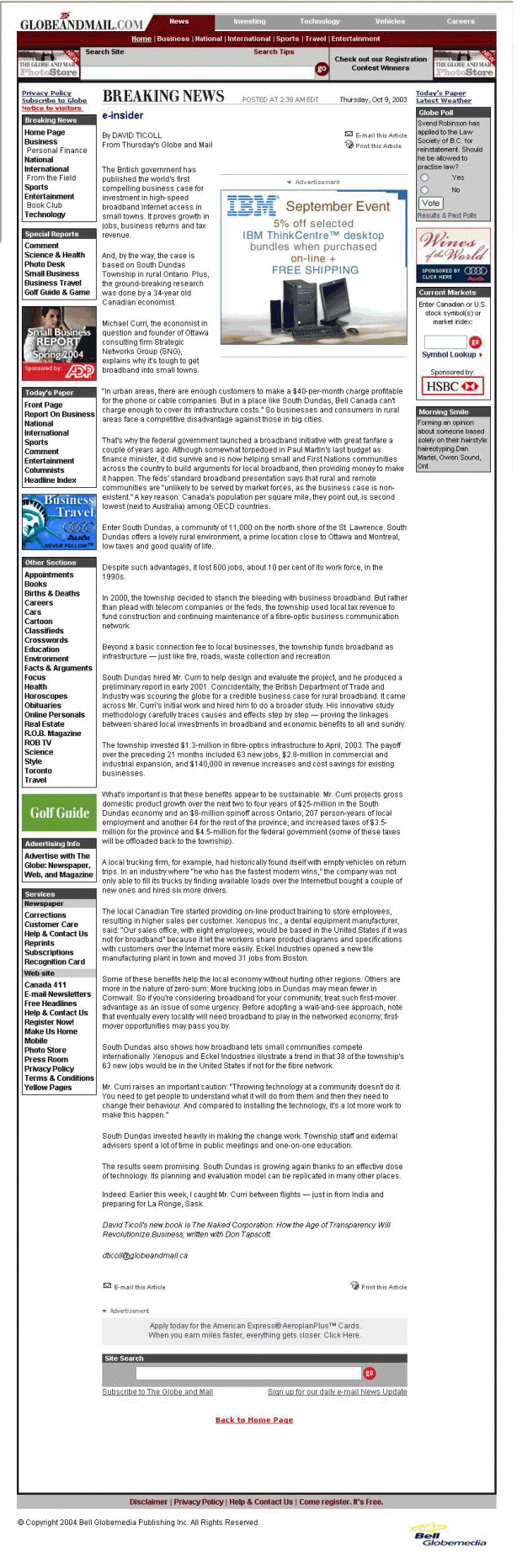
SNG appears in “Canada’s National Newspaper” on world’s first compelling business case for investment in high-speed broadband Internet access in small towns.”
Adjacent to Washington DC and the home of the FCC, Virginia is about to embark on journey along the Broadband Lifecycle. This is one trip the Bristol area in western Virginia is already very familiar with – as in 2007, SNG partnered with FiberToTheHome Council and BVU OptiNet (Bristol Virginia Utility) for step 6 of the broadband lifecycle – measuring outcomes. And with research of impacts, came an opportunity to uncover where to allocate additional fiber resources.
The Center for Information Technology (CIT) of Virginia is targeting surveys to 30 thousand businesses and over 8 thousand homes. With a statewide effort, this is a groundbreaking study on the benefits of a Fiber to the Home (FTTH) deployment. SNG will examine the economic and civic benefits that can be realized, give a holistic picture of the Community Return on Investment – and hopefully drive broadband development and growth throughout the Commonwealth of Virginia.
The project is a follow-up to a successful 2007 SNG study in which the small town of Bristol (17,000 residents) reported big benefits just 12 months after BVU’s initial fiber investment. SNG’s study found that for local businesses, fiber meant operational and sales efficiencies, cost savings, and employment opportunities. Bristol’s newly installed “platform for innovation” had created:
- Dozens of businesses reporting a total increase of $2.7 million in annual sales
- Two-thirds of businesses reporting cost-savings due to fiber use
- Nearly 300 new jobs, including a 10% increase in employment from organizations reporting an increase in sales as a result of the fiber network
Today, the Economic impact study of e‐solutions in the Bristol area is a core project component, quantifying the impacts of implementing e‐solutions from BVU OptiNet’s deployment. In conjunction with the state-wide initiative, SNG is again collecting data in Bristol that will serve as benchmarks for the rest of Virginia, helping identify the most significant and immediate economic and social benefits from e‐solutions. This will help guide Virginia as it makes decisions for what solutions are needed, and where, throughout the Commonwealth.
Findings from the Bristol test bed will be used to take effective awareness and adoption strategies for education, workforce, economic growth, healthcare and community. Learnings will also help prioritize planning activities, workshops, awareness campaigns, training on e‐solutions that will sustain and grow broadband.
Across the globe the 2008-09 global downturn had deep impacts. Many households were stretched thin, looking for ways to supplement lost income or to supplement declining or stagnant salaries.
SNG worked with the e-North Carolina Authority in 2010 to conduct “eSolutions Benchmarking” across the state to understand how households are using broadband to tackle some of their challenges.
The study revealed the potential of broadband for competitiveness and economic opportunity:
- Nearly a third (31%) of the State’s broadband households operate a business from their home;
- The number of households either currently running (31%) or planning to run a business from their home in the
next twelve months (14%) is nearly half (45%) of the State’s broadband
households;
- Even more broadband households are either now using (41%) or planning to use (24%) broadband to sell items online.
That’s nearly two-thirds (65%) of broadband households using it to at least supplement their income;
- Most (85%) of home-based businesses said that broadband was essential to their business. More than half
(54%) said that they would not be in business if they did not have broadband while two in five (41%) would have to relocate if broadband was not available in their community.

In good times and in bad, broadband is critical for community members to earn income (and extra
income). But in bad times, research shows us that home-based businesses and sole proprietorships are more likely to sprout up. More than ever, it is critical for states and communities that want to remain competitive – and even thrive – to have broadband as a platform for innovation and competitiveness.